Donã¢â‚¬â„¢t Use These Freespeech Arguments Ever Again National Constitution Center
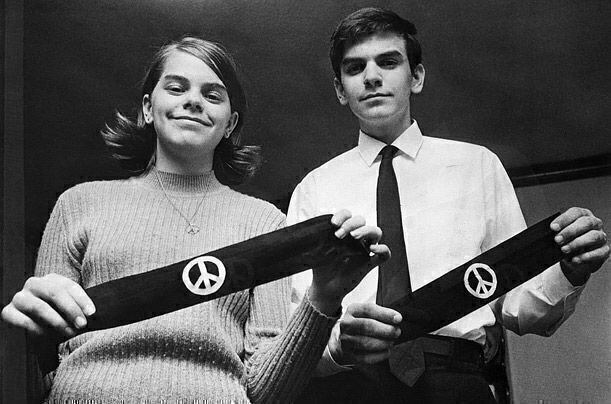
* Editor's Note: TheTinkercase is featured in the National Constitution Center's 2017 Civic Calendar, which yous can download here.
On February 24, 1969, the Supreme Courtroom ruled in Tinker v. Des Moines Independent Customs Schoolhouse District that students at school retain their Showtime Amendment correct to free spoken language.
The story of this landmark example begins 4 years prior, during the early moving ridge of protests confronting the Vietnam State of war. Public demonstrations and university "teach-ins" were growing in response to a ascension death toll and increasing doubts about the motives and goals of the war.
Enter Mary Beth Tinker, a 13-twelvemonth-old pupil at Warren Harding Inferior High School in Des Moines, Iowa. Her story is recounted with intendance in Peter Irons' The Courage of Their Convictions: 16 Americans Who Fought Their Way to the Supreme Courtroom, the primary source for this discussion.
On December 16, 1965, Tinker wore a black armband to schoolhouse to protest the war in Vietnam and to mourn the hundreds of soldiers killed in action—a number that would approach 60,000 past war's end, in addition to many tens of thousands more wounded or missing. After lunch, Tinker was called to the chief'southward office, at which bespeak she was suspended for violating a district ban on such armbands. By calendar week'south end, four other students across the district—her brother John, Christopher Eckhardt, Christine Singer, and Bruce Clark—were also suspended.
The controversy made the forepart folio of The Des Moines Register. The school board president, Ora Niffenegger, defended the ban as a "disciplinary measure out" against "disturbing influence" in school. "Our state's leaders have decided on a course of activity," said Niffenegger, "and nosotros should support them."
The Iowa Civil Liberties Union saw things differently. At a schoolhouse board meeting on December 21, attorney Craig Sawyer insisted that the students be reinstated and the armband rule be repealed. Other members of the community besides spoke, representing views on both sides of the argue. Even so no resolution emerged. When a lath member tried to end give-and-take, Sawyer cried out, "I am enervating that y'all determine it. Accept a stand! That's what yous're here for." Indeed, they did: The board voted five-4 to maintain the ban. The dispute was headed to court.
In the first round, the students lost. On September 1, 1966, Chief Judge Roy Stephenson of the U.S. District Court for the Southern Commune of Iowa upheld the prohibition against armbands. Despite acknowledging that wearing an armband is a "symbolic act" that falls nether the Costless Voice communication Clause of the First Amendment, Judge Stephenson determined that the schoolhouse district's concern for "the disciplined temper of the classroom" outweighed spoken language concerns. Later, the U.Southward. Court of Appeals for the Eighth Circuit was evenly divided. The case was appealed to the U.S. Supreme Court.
The Courtroom heard arguments on November 12, 1968. Dan Johnston, arguing for the students, pointed out that the district had immune other kinds of provocative political speech, including buttons reminiscent of the Nazi regime, and that no disruption of school activities had occurred. Allan Herrick, arguing for the district, insisted that the board exist allowed to preempt the "violence, disorder, and disruption" that could "break out" in response to such provocations.
Here, at the highest level, the students won. Writing for a 7-ii majority, Justice Abe Fortas issued the at present-famous announcement that students and teachers do not "shed their constitutional rights to freedom of speech or expression at the school gate." Student speech can't be censored, he wrote, unless it "materially disrupts classwork or involves substantial disorder or invasion of the rights of others."
He went on:
Under our Constitution, gratis voice communication is not a right that is given but to be so circumscribed that it exists in principle, but non in fact. Liberty of expression would non truly exist if the right could be exercised simply in an area that a benevolent regime has provided as a safe oasis for crackpots. The Constitution says that Congress (and u.s.) may not abridge the correct to free speech. This provision means what it says. We properly read information technology to permit reasonable regulation of speech-connected activities in carefully restricted circumstances. Merely nosotros do not confine the permissible exercise of First Amendment rights to a telephone booth or the four corners of a pamphlet, or to supervised and ordained discussion in a schoolhouse classroom.
In a very brief concurrence, Justice Potter Stewart challenged the idea that children are entitled to the same degree of First Subpoena protections. But the real oestrus came from Justice Hugo Black, whose blistering dissent insisted that the students' armbands had, in fact, disrupted school activities—despite no clear evidence to that effect—and decried "the beginning of a new revolutionary era of permissiveness in this country fostered by the judiciary."
He explained:
Modify has been said to exist truly the law of life, just sometimes the old and the tried and truthful are worth holding. The schools of this Nation have undoubtedly contributed to giving us tranquility and to making us a more law-constant people. Uncontrolled and uncontrollable liberty is an enemy to domestic peace. … Ane does non demand to be a prophet or the son of a prophet to know that, later on the Court'south holding today, some students in Iowa schools—and, indeed, in all schools—will be set, able, and willing to defy their teachers on practically all orders.
Since Tinker, Justice Black has been vindicated, if just partially. In a series of of import cases—Bethel School Commune No. 403 v. Fraser (1986), Hazelwood School District v. Kuhlmeier (1988), and Morse five. Frederick (2007), the Supreme Court has chipped abroad at Tinker'southward commitment to a pupil's Beginning Amendment rights. Significant questions remain as to whether and to what caste a school can punish students for speech expressed off-campus or online.
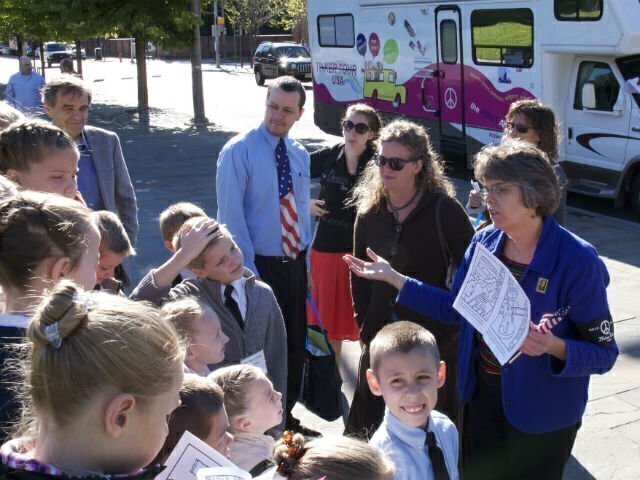
Fifty-fifty so, Mary Beth Tinker is still fighting. At the National Constitution Centre on Constitution Day 2013, she launched her "Tinker Tour" to promote "youth voices, free speech and a free press." The tour continues.
Nicandro Iannacci is a web content strategist at the National Constitution Center.
Source: https://constitutioncenter.org/blog/tinker-v-des-moines-protecting-student-free-speech
0 Response to "Donã¢â‚¬â„¢t Use These Freespeech Arguments Ever Again National Constitution Center"
Post a Comment